
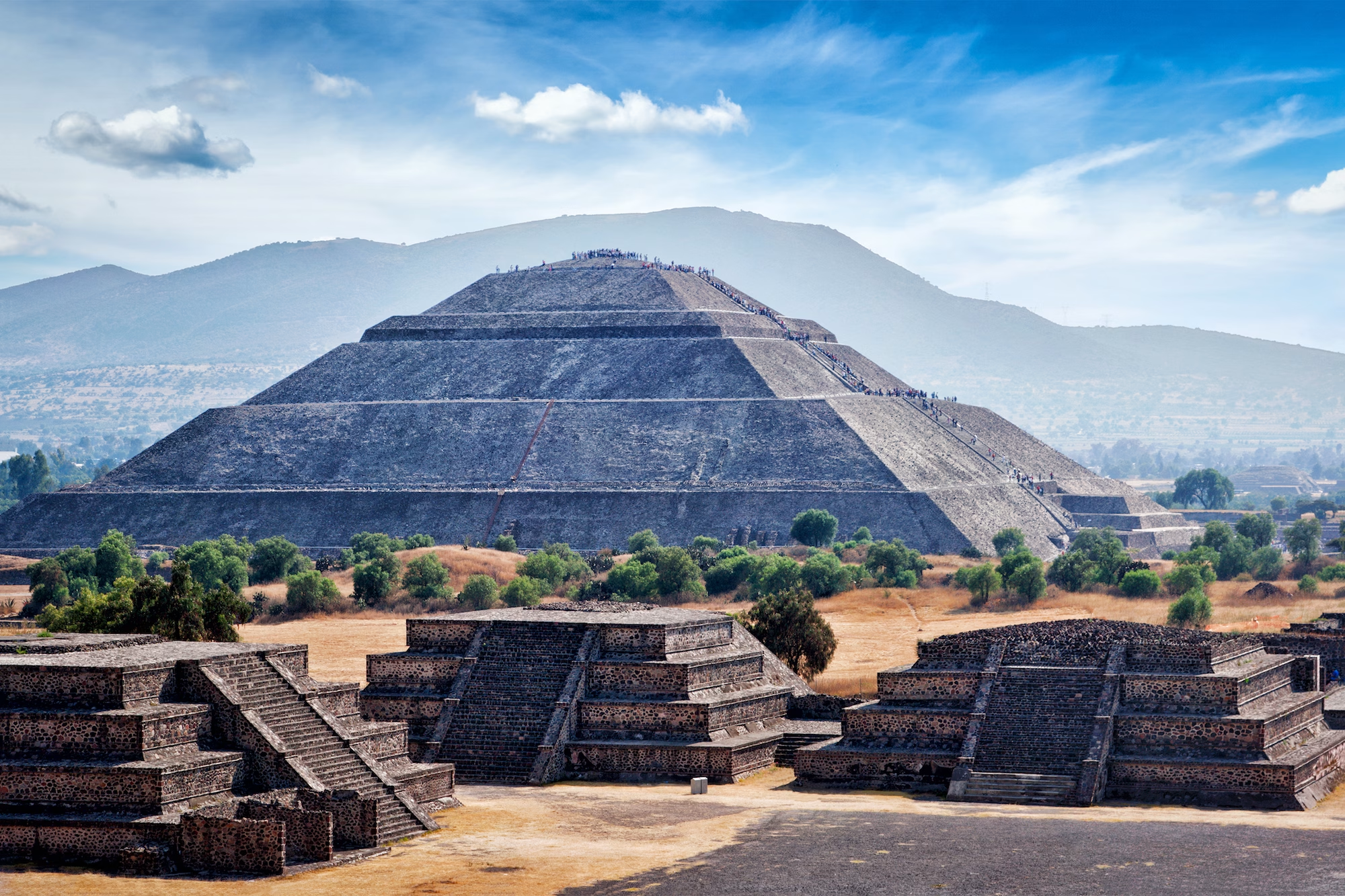
Human history has been shaped by civilizations that developed new technologies, governments, writing systems, architecture, scientific ideas, and cultural traditions. Ancient societies created foundations that continue to influence modern life thousands of years later. Although these civilizations existed in different regions and periods, their achievements contributed to the development of organized communities and human knowledge.
Ancient Mesopotamia
Mesopotamia, located largely between the Tigris and Euphrates rivers, is often associated with some of the earliest urban societies. Cities developed in the region as agriculture became more productive and populations grew.
Mesopotamian societies made important contributions to writing, administration, mathematics, and law. Cuneiform writing was used to record economic transactions, laws, religious information, and other activities.
The development of organized cities and administrative systems demonstrated how complex societies could manage agriculture, trade, taxation, and public institutions.
Ancient Egypt
Ancient Egypt developed along the Nile River and became one of the world’s most influential ancient civilizations. Its achievements included monumental architecture, writing, engineering, agriculture, and artistic traditions.
The pyramids remain among the most recognizable structures from the ancient world. Egyptian society also developed systems for administration and record keeping, while its religious beliefs influenced architecture, art, and burial practices.
Egyptian knowledge of mathematics, medicine, and engineering contributed to the civilization’s ability to build and maintain large-scale projects.
The Indus Valley Civilization
The Indus Valley Civilization developed in parts of present-day South Asia and is notable for its urban planning and sophisticated infrastructure.
Archaeological sites such as Harappa and Mohenjo-daro reveal organized streets, drainage systems, buildings, and evidence of extensive trade. The civilization’s standardized weights and urban organization suggest sophisticated systems of economic and civic management.
Although much about the civilization remains uncertain, its cities demonstrate that complex urban societies developed early in South Asian history.
Ancient China
Ancient Chinese civilizations made major contributions to technology, philosophy, government, and culture. Over different periods, Chinese societies developed innovations and institutions that influenced East Asia for centuries.
Paper, printing technologies, advances in metallurgy, and other developments eventually had effects far beyond China. Philosophical traditions associated with thinkers such as Confucius also influenced ideas about education, ethics, government, and social relationships.
Ancient Greece
Ancient Greece had a lasting influence on philosophy, political thought, science, mathematics, literature, art, and architecture.
Greek city-states developed different political systems, including forms of direct democracy. Philosophers such as Socrates, Plato, and Aristotle explored questions about ethics, knowledge, politics, and society.
Greek mathematical and scientific ideas influenced later scholars, while Greek architecture and artistic traditions continue to inspire modern design.
The Roman Civilization
Rome developed from a city-state into one of the largest empires of the ancient world. Roman achievements included engineering, roads, aqueducts, architecture, military organization, administration, and legal traditions.
Roman law became particularly influential in the development of legal systems in many later societies. Roman infrastructure also demonstrated how governments could build and maintain extensive transportation and water networks.
The Roman Empire eventually declined in the West, but its language, law, architecture, political institutions, and cultural influence continued long afterward.
The Maya Civilization
The Maya civilization developed in Mesoamerica and achieved remarkable advances in astronomy, mathematics, architecture, and writing.
Maya cities included impressive temples, plazas, and other monumental structures. Their calendars and astronomical observations demonstrate sophisticated approaches to tracking time and celestial events.
The Maya also developed one of the most complex writing systems in the ancient Americas.
The Aztec Civilization
The Aztec Empire developed in central Mexico and established a powerful political and economic system before European conquest in the sixteenth century.
Tenochtitlan, the Aztec capital, was a major urban center with impressive architecture, markets, canals, and agricultural systems. The civilization’s achievements demonstrate the complexity of societies that developed independently in the Americas.
Ancient Persia
Persian empires played an important role in the political history of the ancient Near East. The Achaemenid Persian Empire, in particular, governed a vast territory containing many different peoples and cultures.
Persian rulers developed administrative systems that helped manage distant regions. Roads, communication networks, taxation systems, and regional governance supported the empire’s scale and influenced later approaches to administration.
Why Ancient Civilizations Matter
Ancient civilizations are important not only because of their monuments but also because of the ideas and systems they developed. Writing, government, law, urban planning, mathematics, engineering, philosophy, agriculture, and trade all contributed to the foundations of later societies.
Studying ancient history also demonstrates that civilizations influenced one another through migration, trade, warfare, and cultural exchange. Human progress has rarely been the result of a single society working in isolation.
Conclusion
Ancient civilizations changed human history by developing systems and ideas that shaped later generations. Mesopotamia contributed to early urban life and writing, Egypt became renowned for engineering and administration, the Indus Valley Civilization demonstrated sophisticated city planning, while Greece and Rome profoundly influenced philosophy, law, politics, and architecture. Civilizations in China and the Americas made equally important contributions in technology, science, culture, and urban development. Their legacies remain visible today, reminding us that modern society is built upon thousands of years of human innovation and experience.